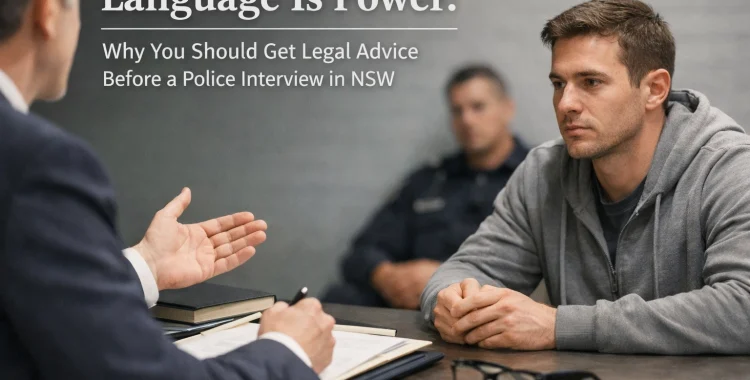
Language Is Power: Why You Should Get Legal Advice Before a Police Interview in NSW
If NSW Police want to interview you, you're facing one of the most critical moments in any criminal matter. What you say, or don't say, in that interview room can determine the outcome of your case before you ever see the inside of a courtroom.
Here's the reality: Police interviews are designed to gather evidence. They are not casual conversations. They are recorded, transcribed, and used against you in court. One poorly chosen word, one inconsistency, one moment of confusion can undermine your entire defence.
This guide explains why getting legal advice before a police interview in Sydney or anywhere in NSW is not just recommended, it's essential.
1. Do I Have to Answer Police Questions in NSW?
No. You have the right to remain silent in NSW.
This is a fundamental legal protection under common law and reinforced by the Evidence Act 1995 (NSW). When police caution you, they must tell you: "You do not have to say or do anything, but anything you say or do may be used in evidence."
What this actually means:
- You are not legally required to answer questions during a police interview
- You cannot be charged or convicted simply for exercising your right to silence
- Remaining silent is not an admission of guilt
However, there are important limitations to the right to silence that many people don't understand. That's why legal advice before making any decision is critical.

2. What Are the Risks of Speaking to Police Without Legal Advice?
Everything you say becomes admissible evidence. There are no "off the record" conversations with police officers.
The risks include:
Unintentional self-incrimination: You may provide information that sounds innocent but places you at a crime scene, establishes your knowledge of events, or contradicts your later defence position.
Inconsistencies: Police are trained to identify inconsistencies in statements. Even minor discrepancies between what you say in an interview and what you later say in court can be used to attack your credibility.
Misinterpretation: Your words can be taken out of context or misunderstood. Once recorded, they are difficult to explain away.
Emotional responses: Police interviews are stressful. You may become emotional, confused, or angry, responses that don't look good when played to a magistrate or jury.
Strategic disadvantage: Without knowing the evidence police already have, you can't assess what information helps or harms your case.
A criminal defence lawyer can assess these risks and advise you on the best approach for your specific circumstances.
3. What Happens If I Say "No Comment" to Police Questions?
A "no comment" interview is a legitimate legal strategy. It means you attend the police interview with your lawyer but decline to answer questions, responding with "no comment" (or a similar phrase) to each question asked.
When this strategy works:
- Police have weak or circumstantial evidence
- You need time to understand the allegations before responding
- Your explanation is complex and requires careful presentation
- There is a risk your words will be misinterpreted
When this strategy might not work: Section 89A of the Evidence Act 1995 (NSW)
If you are charged with a serious indictable offence (one carrying imprisonment of 5 years or more) and you later rely on facts in your defence that you could have disclosed during the police interview but didn't, the court may draw an adverse inference.
In plain English: If you say "no comment" during the interview but later present a defence in court, the magistrate or jury can consider why you didn't mention that defence when first questioned. This doesn't mean remaining silent is an admission of guilt, but it can weaken your case.
This is exactly why you need legal advice before deciding. A lawyer can assess whether Section 89A applies to your situation and whether a "no comment" interview is the right strategic choice.
4. What Is the Police Caution and Why Does It Matter?
The police caution is the formal warning police must give you before conducting a recorded interview. The standard caution in NSW states:
"You do not have to say or do anything, but anything you say or do may be used in evidence. Do you understand?"
Why this matters:
- It triggers your legal rights, including the right to silence and the right to contact a lawyer
- Police must give you a reasonable opportunity to exercise these rights before proceeding
- If police fail to properly caution you or proceed without giving you time to contact a lawyer, your statements may be ruled inadmissible in court
Your rights after being cautioned:
- The right to remain silent
- The right to contact a lawyer before and during the interview
- The right to have your lawyer present during the interview
If police pressure you to proceed without legal representation, that is a red flag. You are entitled to reasonable time to contact a lawyer, and a lawyer present during your interview can ensure police respect your rights.

5. What Police Interview Techniques Should I Know About?
Police are trained in interview techniques designed to elicit responses and test your version of events. These techniques are not illegal, but they are strategic. Common methods include:
Open-ended questioning: Questions like "Tell me what happened that night" encourage you to provide a narrative that may contain admissions or inconsistencies.
Leading questions: Questions that suggest a particular answer, often used to confirm details police already believe are true.
Building rapport: Officers may present as friendly or understanding to make you feel comfortable and more likely to talk.
Strategic silence: Pausing after your answer to create discomfort, hoping you'll fill the silence with additional information.
Challenging inconsistencies: Pointing out contradictions in your account or between your account and other evidence.
Minimization: Downplaying the seriousness of the offence or suggesting cooperation will lead to a better outcome.
A lawyer present during the interview can:
- Identify improper questioning or pressure tactics
- Intervene if police exceed their authority
- Advise you when to pause or decline to answer specific questions
- Ensure the interview is conducted fairly
6. Can Police Lie or Mislead Me During an Interview?
Yes, within limits. Police are allowed to use certain deceptive tactics during interviews, such as:
- Suggesting they have more evidence than they actually do
- Claiming a co-accused has implicated you (when they haven't)
- Implying that cooperation will result in leniency
What police cannot do:
- Make false promises about legal outcomes
- Threaten you with consequences for exercising your right to silence
- Deny you the right to contact a lawyer
- Continue the interview after you've clearly stated you do not wish to participate
A lawyer protects you from these tactics. They can identify when police are bluffing and advise you on what information, if any, is safe to disclose.
7. Should I Prepare a Script or Statement With My Lawyer?
Yes, if you decide to participate in the interview. A prepared statement allows you to present your version of events clearly and consistently without the risks of open-ended questioning.
How this works:
- You meet with your lawyer before the police interview
- You provide your account of events
- Your lawyer drafts a statement that presents your position accurately and strategically
- During the interview, you read the prepared statement and then decline to answer further questions
Benefits of a prepared statement:
- You control the narrative
- You avoid unintentional admissions or inconsistencies
- You meet any disclosure obligations under Section 89A (if applicable)
- You protect yourself from improper questioning
This approach is not appropriate in every case. Your lawyer will assess whether a prepared statement or a "no comment" interview is the better strategy for your circumstances.

8. What Happens If I've Already Spoken to Police Without a Lawyer?
Don't panic. Seek legal advice immediately.
A lawyer can:
- Review what you said during the interview
- Assess whether your statements can be challenged as inadmissible
- Identify any procedural errors by police (failure to caution, denial of access to a lawyer, improper questioning)
- Develop a defence strategy that accounts for your earlier statements
- Advise you on how to respond if police contact you again
Even if you've already made damaging admissions, your case is not over. There are legal avenues to challenge evidence and build a defence.
How Greenfield Criminal & AVO Defence Lawyers Can Help
Language is power in a police interview. The words you choose: or the choice to remain silent: can be the difference between a conviction and an acquittal.
At Greenfield Criminal & AVO Defence Lawyers, we advise clients facing police interviews across Sydney and NSW every day. We know how police conduct interviews, what they're looking for, and how to protect your rights at this critical stage.
We can:
- Attend the police station with you during the interview
- Advise you on whether to participate, provide a prepared statement, or respond with "no comment"
- Identify procedural errors or rights violations
- Develop a strategic approach tailored to your case
If police have contacted you for an interview, don't go in alone.
Call for advice.


About Post Author
