Digital Evidence Nightmare: 7 Mistakes You’re Making When Police Seize Your Phone (And How Sydney Criminal Lawyers Fight Back)

When police seize your phone during a criminal investigation in Sydney, the stakes couldn’t be higher. Your device contains years of private conversations, photos, location data, and personal information that can make or break your case. Unfortunately, NSW Police frequently make critical errors during the seizure process that can compromise the evidence against you.
Understanding these mistakes isn’t just academic: it’s your defence. Each error creates an opportunity for experienced criminal lawyers to challenge the prosecution’s case and protect your rights.
Mistake #1: Failing to Isolate Your Device from Networks
The Error: Police officers often seize your phone and leave it powered on without immediately isolating it from cellular or Wi-Fi networks. This is a fundamental mistake that can corrupt or destroy digital evidence.
When your phone remains connected, several problems occur:
- Cloud services continue syncing automatically
- Apps update in the background, altering timestamps
- You or others can remotely wipe the device
- New data overwrites existing information
How Sydney Criminal Lawyers Fight Back: Your defence team will scrutinise the seizure documentation to determine if police properly isolated your device. If they failed to use a Faraday bag or aeroplane mode immediately upon seizure, we can argue that the evidence is unreliable due to potential contamination.
Courts recognise that continuous network connectivity fundamentally alters a device’s state. When police can’t prove they maintained the device’s original condition, the entire digital evidence chain becomes questionable.

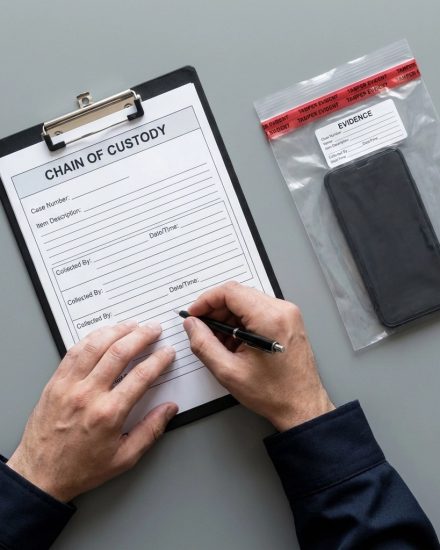
Mistake #2: Botching the Chain of Custody Documentation
The Error: NSW Police must maintain detailed records of who handled your phone, when, and where throughout the entire investigation. Too often, officers fail to properly document these crucial details.
Common chain of custody failures include:
- Missing or incomplete seizure documentation
- Gaps in the timeline of who had possession
- Failure to describe the device’s condition accurately
- Lost or damaged evidence tags
How Sydney Criminal Lawyers Fight Back: We examine every piece of chain of custody documentation with forensic precision. Any gap, inconsistency, or missing record creates reasonable doubt about the evidence’s integrity.
In NSW courts, prosecutors must prove an unbroken chain of custody. When they can’t, judges may exclude the digital evidence entirely under Section 138 of the Evidence Act 1995 (NSW), which allows courts to refuse evidence obtained improperly.
Mistake #3: Inadequate Device Identification and Component Tracking
The Error: Police often treat your smartphone as a single item when it actually contains multiple storage components requiring separate documentation. Modern phones typically include:
- Internal storage
- SIM cards with unique serial numbers
- MicroSD cards (if present)
- External storage devices
Each component can contain different evidence and requires individual chain of custody tracking.
How Sydney Criminal Lawyers Fight Back: We demand complete documentation for every component of your seized device. When police fail to separately identify and track each storage element, we argue that critical evidence may have been lost, contaminated, or switched.
This technical oversight often leads to successful suppression applications, particularly in cases involving serious charges where digital evidence is central to the prosecution’s case.
Mistake #4: Powering On Devices During Seizure
The Error: Well-meaning officers sometimes turn on seized phones to “check what’s there” or attempt basic searches at the scene. This fundamental error immediately compromises the evidence’s forensic integrity.
When police power on your device without proper forensic equipment:
- Background processes alter system files
- Apps launch automatically, changing timestamps
- The operating system writes new data over old information
- Original evidence becomes contaminated beyond recovery
How Sydney Criminal Lawyers Fight Back: Forensic experts can identify when devices were improperly accessed during seizure. We use this technical evidence to demonstrate that police contaminated the digital crime scene, making any subsequent analysis unreliable.
Courts increasingly understand that digital evidence requires the same careful handling as physical evidence. Contamination during seizure can result in complete exclusion of phone evidence.
Mistake #5: Exceeding Search Warrant Limitations
The Error: Even with valid search warrants, police often exceed their authorised scope when examining digital devices. NSW courts require warrants to specify particular information being sought, not blanket authorisation to explore everything on your phone.
Common warrant scope violations include:
- Searching beyond specified time periods
- Accessing unrelated applications or data
- Conducting fishing expeditions through personal files
- Retaining information outside the warrant’s parameters
How Sydney Criminal Lawyers Fight Back: We meticulously compare the actual police search against the warrant’s specific limitations. Any evidence obtained beyond the warrant’s scope violates Section 3E of the Crimes Act 1914 (Commonwealth) and NSW search and seizure laws.
Successful suppression applications often hinge on proving police exceeded their legal authority during digital searches. This requires detailed technical analysis of forensic examination logs against warrant specifications.
Mistake #6: Relying on Invalid “Consent” to Search
The Error: Police frequently claim you “consented” to phone searches during stressful arrest situations. However, legal consent requires specific conditions that officers often ignore:
- Consent must be freely given without coercion
- You must understand what you’re consenting to
- Police threats or intimidation invalidate consent
- Consent can be withdrawn at any time
How Sydney Criminal Lawyers Fight Back: We examine the entire context of your alleged consent, including:
- Recording of the interaction (if available)
- Number of officers present
- Whether you were under arrest
- Your emotional state and understanding
- Any promises or threats made by police
Courts regularly find that “consent” given during high-pressure police encounters doesn’t meet legal standards. When consent is invalid, any evidence obtained becomes inadmissible.
Mistake #7: Illegal Retention Periods
The Error: NSW Police cannot retain your seized devices indefinitely without demonstrating ongoing evidentiary need. Yet many investigations drag on for months or years while your phone sits in an evidence locker, often being searched repeatedly without additional warrants.
Legal problems with extended retention include:
- Lack of regular review of retention necessity
- Using old seizures for new, unrelated investigations
- Failure to return devices when investigations conclude
- Searching devices years later without fresh warrants
How Sydney Criminal Lawyers Fight Back: We actively monitor retention periods and file applications for return of property when police exceed reasonable investigation timeframes. Courts have consistently ruled that governments cannot retain digital devices indefinitely without clear justification.
In landmark cases, judges have excluded evidence obtained from devices held beyond reasonable investigation periods, recognising that indefinite retention violates fundamental property rights.
Your Next Steps: Protecting Your Rights
If NSW Police have seized your phone, don’t assume the evidence against you is bulletproof. Each of these common mistakes creates opportunities for experienced criminal defence lawyers to challenge the prosecution’s case.
Immediate actions you should take:
- Document everything you remember about the seizure
- Request copies of all police documentation
- Avoid discussing your case on social media or with others
- Contact a specialised criminal defence lawyer immediately
The digital evidence in your phone could determine whether you face conviction or walk free. Don’t leave your future to chance by hoping police followed proper procedures: they often don’t.
At Greenfield Lawyers, we’ve successfully challenged digital evidence in hundreds of NSW criminal cases. Our technical expertise and aggressive defence strategies have helped clients avoid conviction even when the evidence initially seemed overwhelming.
Ready to fight back against digital evidence? Contact our Sydney criminal defence team today. We’ll examine your case for police errors and build the strongest possible defence to protect your freedom and reputation.
Time is critical in digital evidence cases. The sooner we can review the police seizure and examination procedures, the better positioned we’ll be to identify errors and suppress compromised evidence.
Your phone might contain the key to your defence( let us find it.)


About Post Author
