Legal Aid NSW Criminal Law: Eligibility, Duty Lawyer, Apply
Legal Aid NSW criminal law is a government service that pays for your lawyer when you face criminal charges but cannot afford legal representation. If you meet strict eligibility requirements based on your income and assets, Legal Aid NSW will cover the cost of your defence lawyer or assign one to represent you. This support extends to serious criminal matters in the Local Court, District Court, and Supreme Court across New South Wales. The service also provides duty lawyers at court who can assist you on the day without a prior appointment.
This article explains how to apply for Legal Aid, what services duty lawyers provide, and who qualifies for assistance. You will learn about the application process, what happens after you submit your form, and whether you can use Legal Aid funding with a private criminal lawyer of your choice. We cover everything you need to know from first contact through to court representation.
Why legal aid in NSW criminal cases matters
Your criminal charge carries serious consequences that can affect your freedom, employment, and future opportunities. Legal representation makes the difference between a conviction that follows you for years and a case dismissed on procedural grounds. Police prosecutors and the Director of Public Prosecutions employ trained legal professionals who understand court procedure, evidence rules, and sentencing law. You face these experienced advocates alone if you cannot afford a lawyer.

Without proper legal representation, you risk missing crucial defences, accepting unfair plea deals, or receiving harsher penalties than necessary.
Private criminal lawyers in Sydney charge between $3,000 and $15,000 for a straightforward Local Court matter, with complex cases reaching $50,000 or more. Most people cannot afford these fees when facing criminal charges. Legal aid nsw criminal law bridges this gap by funding your defence when your income and assets fall below specified thresholds. The service ensures that your financial situation does not determine whether you receive competent legal representation in court.
How to apply for Legal Aid NSW criminal law
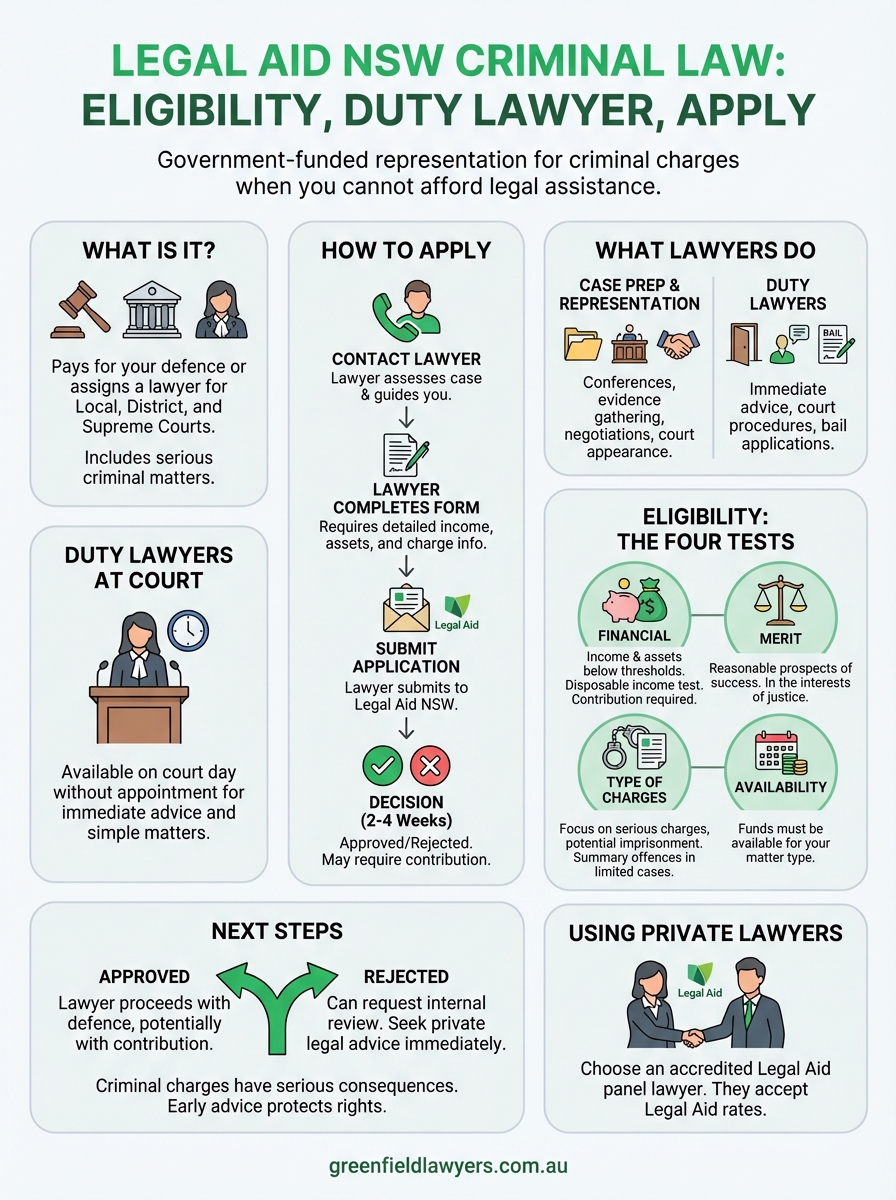
You start your Legal Aid application by contacting a criminal lawyer who will assess your case and guide you through the process. Your lawyer completes the application form on your behalf, attaching supporting documents that prove your financial situation and explain your criminal charges. The application goes directly to Legal Aid NSW for assessment, and your lawyer manages all communication with the authority.
Completing the application form
The application form requires detailed information about your income, assets, and criminal charges. You must provide recent payslips, bank statements, Centrelink documentation, and proof of any assets you own. Your lawyer gathers these documents and ensures the application meets all requirements before submission. Legal Aid NSW reviews applications based on strict criteria covering your financial means, the merit of your case, and whether funds are available for your type of matter.

Your application will be rejected if you fail to provide complete financial documentation or if your income exceeds the eligibility thresholds.
Applications typically take two to four weeks for assessment, though urgent matters receive priority treatment. You can apply before your first court date or after charges are laid, but earlier applications give your lawyer more time to prepare your defence.
What happens after you apply
Legal Aid NSW sends a decision letter to your lawyer explaining whether your application was approved, rejected, or requires additional information. Approved applications specify what legal services are covered and whether you must contribute financially to your own defence. Rejected applications include reasons for the decision and information about your right to request an internal review. Your lawyer receives instructions about how to proceed with your case based on the outcome of your legal aid nsw criminal law application.
What Legal Aid NSW criminal lawyers do
Legal Aid NSW criminal lawyers represent you in court proceedings and provide expert legal advice throughout your case. These lawyers work exclusively for clients who meet financial eligibility requirements, offering the same quality of representation you would receive from private solicitors. Your assigned lawyer prepares your defence, gathers evidence, negotiates with prosecutors, and appears on your behalf at all court hearings related to your criminal charges.
Court representation and case preparation
Your Legal Aid lawyer conducts detailed conferences where you explain your version of events and provide instructions for your defence. The lawyer reviews all prosecution evidence, identifies weaknesses in the case against you, and develops legal arguments to support your position. They prepare court documents, file necessary applications, and correspond with witnesses who can support your case. Your lawyer also negotiates with police prosecutors or the Director of Public Prosecutions to seek charge withdrawals or reduced charges where appropriate.
Legal Aid lawyers have the same professional obligations and duties as private criminal lawyers, ensuring you receive competent representation regardless of your financial situation.
Duty lawyer services at court
Duty lawyers attend court each day to assist people who do not have their own lawyer arranged. You can speak with a duty lawyer on the morning of your court appearance without booking an appointment. These lawyers provide immediate advice about your charges, explain court procedures, and can represent you for straightforward matters like bail applications or adjournments. Duty lawyers handle legal aid nsw criminal law matters at Local and District Courts across Sydney and regional New South Wales.

Who is eligible for Legal Aid NSW
Legal Aid NSW uses four separate tests to determine whether you qualify for assistance with your criminal matter. You must pass all four tests before receiving funding for your defence. The authority assesses your financial situation, the merit of your case, the type of charges you face, and whether funds remain available for allocation to new applicants. Each test applies strict criteria that determine whether your application proceeds to the next stage of assessment.
Financial eligibility requirements
Your income and assets must fall below specified thresholds that Legal Aid NSW updates regularly. The authority examines your gross weekly income, adding any Centrelink payments, wages, rental income, or other financial support you receive. Assets like property, vehicles, and savings accounts count towards your total wealth, with your family home usually excluded from calculations. You must also prove you cannot pay for private legal representation through the disposable income test, which considers your regular living expenses and financial commitments.

Legal Aid NSW requires you to contribute towards your defence costs even when approved, with contribution amounts based on your income level and the complexity of your case.
Merit and case requirements
Your criminal charges must meet the merit test, which assesses whether reasonable prospects exist for a favourable outcome in your case. Legal Aid NSW evaluates the strength of prosecution evidence, available defences, and whether representation serves the interests of justice. The authority prioritises serious charges like indictable offences, sexual assault, domestic violence matters, and cases involving potential imprisonment. Summary offences receive funding only in limited circumstances where the charges carry significant consequences. Legal aid nsw criminal law also requires that funds remain available for your type of case when you apply, as budgetary constraints affect approval rates throughout the financial year.
Using Legal Aid NSW with a private lawyer
You can use Legal Aid NSW funding to pay a private criminal lawyer of your choice rather than accepting a lawyer assigned by Legal Aid. Your chosen lawyer must hold current accreditation on the Legal Aid NSW panel for criminal law matters and agree to accept legal aid rates for their services. This option gives you control over who represents you while still receiving government funding for your defence costs when you meet the eligibility requirements.
Selecting an accredited lawyer
Private lawyers who accept legal aid nsw criminal law cases charge reduced fees set by Legal Aid NSW, typically lower than their standard commercial rates. You contact the lawyer directly to discuss your case and confirm they will represent you under the legal aid scheme. Your lawyer then submits the application on your behalf and manages all communication with Legal Aid NSW throughout your matter.
Panel lawyers must meet strict experience requirements before Legal Aid NSW approves them to accept funded criminal cases. Your private lawyer follows the same funding guidelines and detailed reporting obligations as Legal Aid staff solicitors when representing you under the scheme.
Private solicitors on the Legal Aid panel provide the same quality of representation as lawyers employed directly by Legal Aid NSW.
Next steps
Legal aid nsw criminal law provides government-funded representation when you cannot afford a private lawyer, but strict eligibility requirements mean not everyone qualifies for assistance. You must pass financial tests, merit assessments, and availability requirements before receiving funding for your criminal defence. The application process takes two to four weeks through an accredited lawyer who completes the paperwork on your behalf.
Many people who apply for Legal Aid NSW discover their income exceeds the thresholds or their charges do not meet funding priorities. Criminal charges carry serious consequences regardless of your financial situation, and early legal advice protects your rights from the moment police contact you. Contact Greenfield Lawyers for expert criminal defence representation in Sydney. Our experienced team provides urgent advice and court representation with flexible payment arrangements, ensuring you receive skilled legal support when facing criminal charges.


About Post Author
