Standard AVO Conditions in NSW: Mandatory Orders Explained
Every Apprehended Violence Order in New South Wales includes standard AVO conditions NSW courts must impose by law. These mandatory orders appear as Condition 1 on every AVO document and prohibit three specific actions: assaulting or threatening the protected person, stalking or harassing them, and damaging their property or harming their animals. You cannot negotiate these conditions away. They apply whether you consent to the AVO or fight it in court, and they remain in force for the entire duration of the order.
This article breaks down what each standard condition means in practice, how they differ from the additional restrictions courts can add, and what happens if you breach them. You’ll learn how to comply with these mandatory orders, understand when they work together with other AVO conditions, and discover why getting legal advice early matters. Understanding these conditions protects you from accidentally breaching the order and helps you avoid criminal charges that carry serious penalties including possible imprisonment. We’ll also explain when legal representation becomes essential for your case.
Why standard AVO conditions matter
The standard AVO conditions NSW courts impose serve as the foundation for every protection order issued in the state. These conditions create a baseline of legal protection that applies regardless of the specific circumstances of your case. Courts cannot remove or weaken these mandatory orders, even if both parties request it. The conditions exist to prevent the most serious forms of domestic and personal violence, giving the protected person immediate legal recourse if you engage in prohibited conduct. Understanding these conditions protects you from unintentional breaches that could lead to criminal charges and imprisonment.

Universal application across all AVOs
These standard conditions appear on every Apprehended Domestic Violence Order (ADVO) and every Apprehended Personal Violence Order (APVO) issued in New South Wales. The law requires courts to include them whether your case involves an intimate partner, family member, neighbour, or complete stranger. You face the same mandatory prohibitions if you consent to the order without admissions as you would if the court makes the order after a contested hearing. Police AVOs and privately applied AVOs both carry identical standard conditions. This universal application means you cannot argue the conditions are unfair or inappropriate to your particular situation.
The mandatory nature of standard AVO conditions ensures consistent protection across all violence order cases in NSW.
Setting baseline protection
Standard conditions establish the minimum level of protection courts must provide to every person seeking an AVO. They prohibit conduct that already constitutes criminal offences under NSW law, including common assault, stalking, intimidation, and property damage. Courts can add additional restrictions that limit your contact, movement, or behaviour, but they cannot reduce protection below the standard conditions. These baseline orders remain in force for the full duration of your AVO, whether it lasts six months or indefinitely. The protected person gains immediate legal grounds to call police if you breach any standard condition, triggering potential arrest and criminal charges.
How to comply with standard AVO conditions
Compliance with standard AVO conditions NSW courts impose requires you to completely avoid three categories of prohibited conduct toward the protected person. You must understand these restrictions apply twenty-four hours a day, seven days a week, for the entire duration of your AVO. The conditions remain in force whether you live together, communicate regularly for legitimate reasons, or have no contact whatsoever. Courts make no exceptions for special occasions, emotional stress, or mutual agreement between you and the protected person. Your responsibility to comply continues even if the protected person contacts you first, invites you to events, or requests your help. Police can arrest and charge you for any breach, regardless of who initiated the contact or situation.
Understanding what you cannot do
The three mandatory prohibitions cover assault, threats, stalking, harassment, intimidation, and property damage or animal harm. You cannot physically touch the protected person in any violent or aggressive manner, including pushing, grabbing, slapping, or punching. Threats include verbal statements, written messages, or gestures that communicate your intention to harm them. Courts interpret these prohibitions broadly to capture any conduct that could reasonably be understood as threatening or intimidating. You cannot follow the protected person, watch their home or workplace, make repeated unwanted contact, or engage in any behaviour designed to frighten or control them.

Property damage and animal harm prohibitions extend to anything the protected person owns or possesses. You cannot damage their car, break their belongings, access their accounts without permission, or harm any animal in their care. These restrictions apply whether you act intentionally or recklessly, meaning you face potential charges even if you claim the damage was accidental or you didn’t mean to cause harm.
Your compliance obligations continue regardless of whether the protected person contacts you or agrees to meet.
Taking practical steps to comply
Document every interaction you have with the protected person to protect yourself from false allegations. Keep copies of all messages, emails, and correspondence showing who initiated contact and what was discussed. Screenshot social media interactions and save voicemail recordings. This evidence becomes crucial if you face breach allegations later. Avoid situations where you might accidentally encounter the protected person, such as frequenting places they regularly visit. Change your daily routines if necessary to eliminate the risk of accidental meetings that could be misinterpreted as stalking or harassment.
Instruct family members and friends not to pass messages between you and the protected person unless your AVO specifically allows such contact through third parties. Delete the protected person’s phone number and block their social media accounts to prevent accidental contact. These steps demonstrate your genuine commitment to compliance and reduce the likelihood of misunderstandings that could result in criminal charges.
What the mandatory AVO orders include
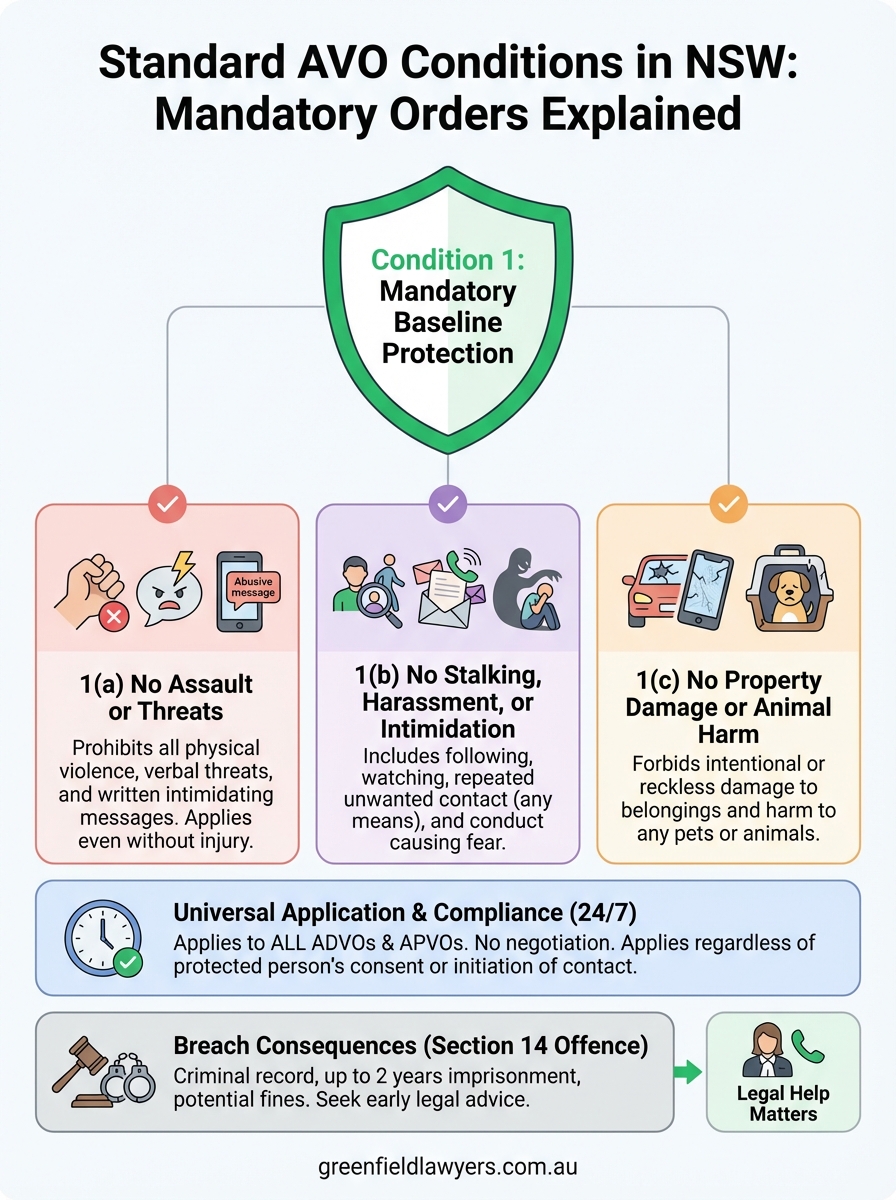
The standard AVO conditions NSW courts impose appear as Condition 1 on every AVO document and consist of three distinct prohibitions labeled 1(a), 1(b), and 1(c). Courts describe these collectively as “Orders about behaviour” and they apply to conduct directed at both the protected person and anyone they share a domestic relationship with. This extended protection covers family members, current or former partners, and anyone living with the protected person. You face criminal charges if you breach any part of Condition 1, regardless of which specific prohibition you violate. The conditions remain identical whether your AVO is provisional, interim, or final, and they apply with equal force in both domestic violence and personal violence orders.
Condition 1(a): No assault or threats
This prohibition prevents you from physically assaulting the protected person or threatening them in any manner. Assault includes any unwanted physical contact, from pushing or grabbing to more serious violence like punching or kicking. Courts interpret assault broadly, covering even minor physical contact if the protected person does not consent to it. You also breach this condition by attempting to assault someone, even if you don’t make actual contact. Threats include verbal statements, written messages, text messages, social media posts, or any communication suggesting you intend to harm the protected person. Courts assess threats objectively, asking whether a reasonable person receiving your communication would interpret it as threatening.
Condition 1(b): No stalking, harassment, or intimidation
Stalking involves following, watching, or approaching the protected person repeatedly without their consent. You breach this condition by waiting outside their home or workplace, driving past their residence multiple times, or appearing at places they regularly visit. Harassment covers repeated unwanted contact through any means, including phone calls, text messages, emails, or third parties passing messages on your behalf. Courts consider the frequency, duration, and nature of your contact when determining whether your behaviour constitutes harassment. Intimidation means conduct designed to cause fear or apprehension in the protected person. You can intimidate someone through physical presence, aggressive gestures, or implicit threats that suggest potential violence without making explicit statements.

Courts interpret intimidation broadly to include any conduct designed to cause fear, regardless of whether you make explicit threats.
Condition 1(c): No property damage or animal harm
This condition prohibits you from intentionally or recklessly destroying or damaging property belonging to or possessed by the protected person. Property includes vehicles, homes, personal belongings, mobile phones, computers, and any other physical items the protected person owns or controls. You breach this condition even if you only damage property through reckless behaviour rather than deliberate destruction. The prohibition extends to harming any animal the protected person owns or possesses, covering pets, livestock, and any creature in their care. Courts treat animal harm seriously because perpetrators often use threats or violence against animals to intimidate and control victims. You can face charges under this condition for killing, injuring, or threatening to harm animals, regardless of your stated motivation.
Standard conditions protect not only the named protected person but also anyone in their domestic relationship circle. This extension means you breach the order by assaulting the protected person’s family member, damaging property belonging to their partner, or harming an animal owned by their relative. Courts include this broader protection because domestic violence often affects entire families, not just the primary victim. You need to understand exactly who falls within this protected group to avoid accidentally breaching your AVO through conduct directed at extended family members.
How standard orders interact with extra conditions
Courts combine standard AVO conditions NSW mandates with additional restrictions tailored to your specific case circumstances. The mandatory orders under Condition 1 remain in force regardless of what extra conditions courts impose. These additional restrictions build upon the baseline protection by limiting your contact, movement, or behaviour in ways standard conditions alone cannot achieve. You must comply with both types of conditions simultaneously, understanding how they work together to create comprehensive protection for the person named on your order. Additional conditions never replace or override standard conditions; they only expand the scope of prohibited conduct beyond the mandatory baseline.
When courts add restrictions beyond standard conditions
Additional conditions become necessary when standard protections prove insufficient to ensure the protected person’s safety. Courts impose these extra restrictions based on your history with the protected person, the nature of alleged violence or threats, and specific risks identified in police statements or the protected person’s evidence. Common additional conditions prevent you from approaching or contacting the protected person (Condition 2), prohibit you from going near specific locations like their home or workplace (Conditions 8 and 9), or ban you from living at certain addresses (Condition 7). Courts may also add conditions restricting your contact after consuming alcohol or drugs (Condition 4) if substance abuse contributed to alleged violence. These additional restrictions address particular risks standard conditions cannot cover, such as preventing you from waiting outside the protected person’s workplace or sending messages through third parties.
Additional AVO conditions expand protection by addressing specific risks that mandatory standard orders cannot prevent.
How additional conditions work alongside mandatory orders
Your obligations under standard conditions continue even when courts add extra restrictions to your AVO. If courts impose Condition 2 preventing any contact except through lawyers, you still cannot assault, threaten, or intimidate the protected person should accidental contact occur. Standard conditions apply during any interaction, whether lawful or unlawful under additional restrictions. Courts structure additional conditions to complement rather than conflict with mandatory orders. For example, Condition 6 allows limited contact regarding children through written parenting arrangements while standard conditions ensure any permitted contact remains non-threatening and non-intimidating. You face separate breach charges for violating standard conditions and additional restrictions simultaneously. Police can charge you with contravening your AVO by approaching the protected person’s home (breaching Condition 8) while also charging you with assault (breaching Condition 1a) if violence occurs during that prohibited approach.
Breaches, penalties and criminal records
Breaching standard AVO conditions NSW courts impose constitutes a serious criminal offence under section 14 of the Crimes (Domestic and Personal Violence) Act 2007. Police can arrest and charge you immediately upon discovering a contravention, regardless of whether the protected person wants to pursue charges. The prosecution bears responsibility for proving your breach beyond reasonable doubt in criminal court. You face potential imprisonment, criminal conviction, and lasting impacts on your employment, travel, and professional licences. Courts treat AVO breaches seriously because they undermine protection orders designed to prevent violence and harassment. Understanding what constitutes a breach, the penalties courts impose, and the criminal record consequences helps you appreciate the importance of strict compliance with every condition on your order.
What counts as breaching standard AVO conditions
You breach your AVO by contravening any part of Condition 1 or any additional restrictions courts imposed. A single act of assault, one threatening message, or any instance of following the protected person all constitute separate breaches. Police can charge you with multiple contraventions arising from the same incident if you violate several conditions simultaneously. Courts consider breaches proven when prosecutors establish you knew the AVO existed, you engaged in prohibited conduct, and your actions fell within the scope of conditions listed on the order. You cannot defend a breach by claiming you forgot about the order, believed it had expired, or thought the protected person consented to the contact.
Breaches occur the moment you engage in prohibited conduct, regardless of the protected person’s response or wishes. Courts reject defences arguing the protected person invited contact, asked you to attend their home, or initiated communication. Your responsibility to comply with standard conditions continues even when the protected person actively encourages you to breach the order. Police can charge you with contravention based solely on your actions, without requiring evidence the protected person felt threatened or afraid during the incident.
Courts hold you responsible for breaching AVO conditions regardless of whether the protected person consented to or encouraged the prohibited contact.
Penalties you face for contravening an AVO
Section 14 offences carry a maximum penalty of two years imprisonment for standard breaches. Courts impose harsher penalties when you contravene your AVO while committing an offence of violence, such as assaulting the protected person during prohibited contact. Legislation requires courts to impose full-time imprisonment for violent breaches unless you demonstrate exceptional circumstances justifying another penalty. Magistrates consider your criminal history, the seriousness of your breach, whether you have contravened AVOs previously, and the impact on the protected person when determining appropriate sentences. First-time breaches involving minor technical contraventions might result in fines, good behaviour bonds, or community service orders rather than imprisonment. Serious breaches involving violence, repeated contraventions, or deliberate defiance of court orders typically attract immediate custody sentences.

Courts can also extend the duration of your existing AVO when you breach conditions, adding months or years to the protection order. This extension punishes your non-compliance while providing continued protection to the person you harmed. Police may apply for additional conditions restricting your movement or contact beyond those already imposed if your breach demonstrates existing restrictions prove insufficient.
Criminal record consequences
An AVO itself does not create a criminal conviction on your record. However, police charge you with a criminal offence when you breach standard conditions, and courts convict you if prosecutors prove the contravention. This conviction appears on your National Police Certificate and remains visible to employers, licensing authorities, and immigration officials conducting background checks. Professional licensing bodies can refuse or cancel security licences, working with children checks, firearms licences, and other credentials based on AVO breach convictions. Employers in education, healthcare, security, and government sectors often reject applicants with domestic violence-related criminal records.
Immigration consequences affect visa holders and Australian residents seeking citizenship. Breaching an AVO can result in visa cancellation under character provisions in the Migration Act, particularly when your conviction involves violence or repeated contraventions. Courts consider AVO breach convictions when assessing whether you pose a risk to the Australian community. These convictions remain permanently visible on police checks unless you successfully apply for a spent conviction order after completing your sentence and maintaining good behaviour for the required period.
When to get legal help about AVO conditions
You should seek legal advice immediately when police serve you with an AVO application or when you face breach allegations. Early legal representation helps you understand your obligations under standard AVO conditions NSW courts impose and identify potential defences to the application or charges. Criminal defence lawyers experienced in AVO matters can negotiate additional conditions before courts make final orders, protecting your ability to work, maintain family relationships, and live in your home. Waiting until your court date to seek legal help limits your lawyer’s ability to gather evidence, interview witnesses, and prepare your defence properly. Police often misapply AVO provisions or pursue orders without sufficient grounds, making early legal intervention crucial to protecting your rights.
Early legal advice prevents costly mistakes
Contact a criminal defence lawyer as soon as police contact you about an alleged AVO breach or serve you with an application. Lawyers can advise whether police have grounds to charge you, help you avoid making damaging admissions during police interviews, and ensure you understand every condition on your order. Early intervention allows your lawyer to gather evidence immediately, including text messages, CCTV footage, and witness statements that could prove your innocence or demonstrate the protected person encouraged contact. These materials often disappear or become unavailable if you delay seeking legal help until weeks or months after the alleged incident.
Early legal representation protects you from making statements to police that could later strengthen breach charges against you.
Complex cases require specialist representation
Your case requires specialist criminal lawyers when police charge you with AVO breaches alongside serious criminal offences, when additional conditions threaten your employment or housing, or when you face indefinite orders. Lawyers specialising in AVO defence understand how to challenge applications lacking proper grounds, negotiate reduced conditions that allow necessary contact with children, and present compelling arguments for dismissal or withdrawal. Representing yourself risks accepting inappropriate conditions or admitting facts that could support future breach charges against you.
Bringing it all together
Understanding standard avo conditions nsw courts impose protects you from unintentional breaches that carry serious criminal penalties. Every AVO includes Condition 1 prohibiting assault, threats, stalking, harassment, intimidation, property damage, and animal harm. These mandatory orders remain in force regardless of additional restrictions courts add to your order. You cannot negotiate away standard conditions or claim the protected person consented to prohibited contact. Breaching any standard condition triggers criminal charges under section 14, potentially resulting in imprisonment and permanent criminal convictions affecting your employment, licensing, and immigration status.
Courts enforce AVO conditions strictly because protection orders exist to prevent violence and harassment. Your compliance requires understanding exactly what conduct the mandatory orders prohibit, documenting all interactions with the protected person, and avoiding situations that could lead to accidental breaches. Legal representation becomes essential when police serve you with an AVO application or charge you with contravention offences. Contact Greenfield Lawyers immediately for expert criminal defence advice protecting your rights throughout AVO proceedings.


About Post Author
