What Is Legal Professional Privilege? Australia’s Key Rules
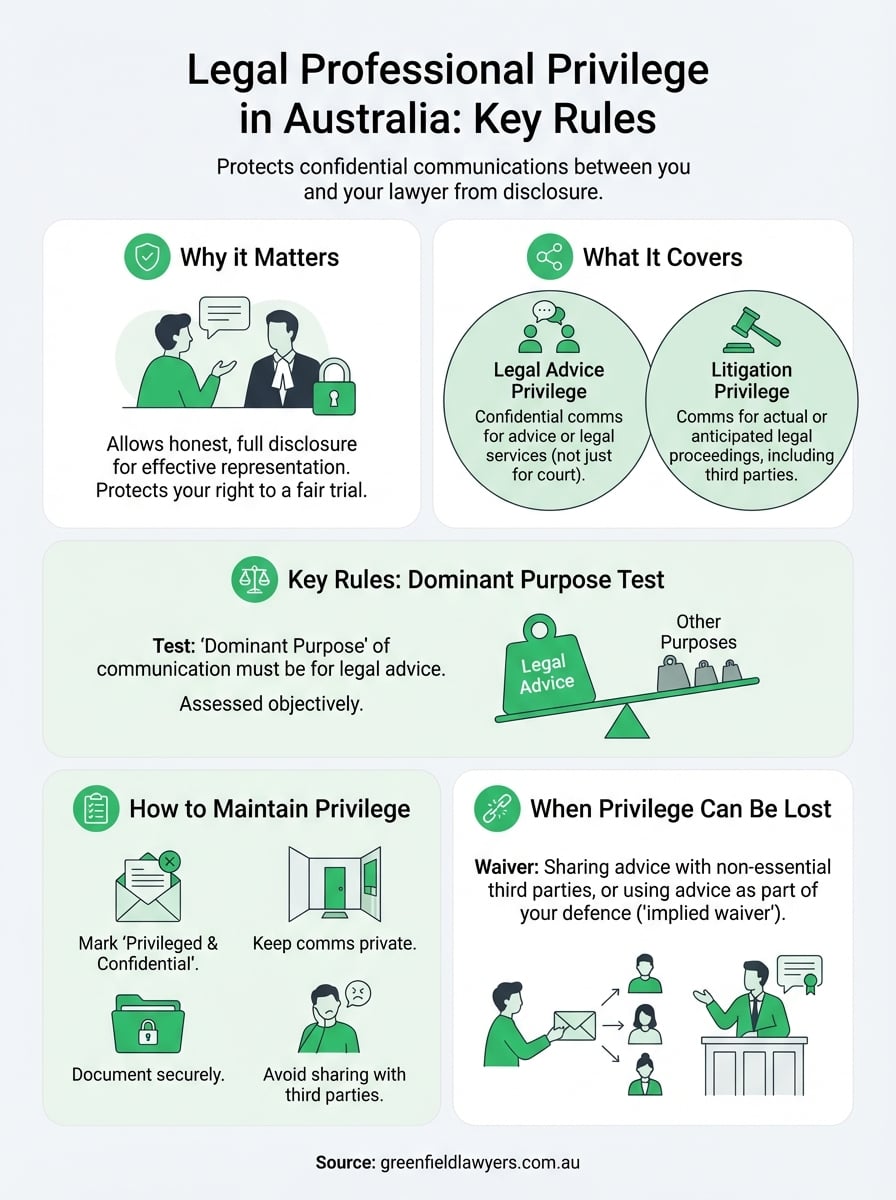
What is legal professional privilege? It protects the confidential conversations between you and your lawyer from being disclosed to police, prosecutors, or courts. This protection exists because our legal system depends on you being able to speak freely with your lawyer without fear that your words will be used against you. Whether you’re facing criminal charges or seeking legal advice about a potential issue, this privilege shields your communications so you can get honest guidance about your situation.
This article explains how legal professional privilege works in Australia, when it applies to your communications, and what steps you need to take to maintain that protection. You’ll learn the key rules that determine whether your conversations are protected, see practical examples of privilege in action, and understand the common ways people accidentally lose this protection. By the end, you’ll know exactly what you can discuss with your lawyer in confidence and how to keep those communications secure.
Why legal professional privilege matters
Understanding what is legal professional privilege becomes crucial when you face criminal charges or police questioning. This protection allows you to tell your lawyer everything without holding back, even details that might seem incriminating or embarrassing. Your lawyer cannot defend you effectively if you hide facts or omit important information because you fear disclosure.
It protects your right to a fair defence
The legal system requires you to have access to confidential legal advice so you can make informed decisions about your case. Without this protection, you would face an impossible choice: either get legal advice and risk that advice being used against you, or navigate the criminal justice system alone. Police and prosecutors cannot force your lawyer to reveal your conversations, which means you can discuss potential defences, admission of facts, and legal strategies without creating evidence against yourself.

It encourages honest communication
You need to share the complete picture with your lawyer for them to build the strongest possible defence. Privilege ensures you can disclose unfavourable facts, admit mistakes, and discuss concerns openly without those admissions becoming prosecution evidence. Your lawyer can then advise you on the real strength of your case, identify genuine risks, and develop strategies based on all the facts rather than a sanitised version of events.
“Legal professional privilege protects the confidence in communications made between client and legal adviser to promote the administration of justice by encouraging full and frank disclosure.”
This protection extends beyond just criminal cases. Whether you’re dealing with AVO matters, traffic offences, or any other legal issue, privilege gives you the freedom to seek guidance without creating additional legal exposure for yourself.
How to use legal professional privilege
Mark communications clearly
You should clearly identify privileged communications when you create them, particularly in written form. Label emails to your lawyer as “Privileged and Confidential” in the subject line, and mark documents you prepare for your lawyer with the same notation at the top. This marking helps establish your intention to keep the communication confidential and makes it harder for others to argue you waived privilege through careless handling.
Your lawyer will typically do the same when sending advice to you. These markings serve as evidence that both parties understood the communication was privileged at the time it was made.
Keep conversations confidential
You must ensure no unauthorised third parties are present when you speak with your lawyer. Having friends, family members, or colleagues present during legal consultations can destroy privilege because the conversation is no longer confidential. The only exceptions are people who need to be there for the lawyer to provide advice, such as interpreters, your spouse in certain circumstances, or other lawyers working on your case.

“A communication must have been made confidentially to attract privilege, which means that where a communication is made in front of a third party, privilege will likely not apply.”
Document your discussions properly
You should keep records of your privileged communications secure and separate from other documents. Store emails from your lawyer in a dedicated folder, and keep hard copies of legal advice in a secure location. Avoid mixing privileged communications with business records or general correspondence that might need to be disclosed in other contexts.
If you take notes during meetings with your lawyer, clearly mark them as privileged and store them securely. These notes can themselves be protected by privilege, but only if you take proper steps to maintain their confidential nature.
What legal professional privilege covers
Understanding what is legal professional privilege requires knowing exactly which communications receive protection. Privilege covers two main categories: legal advice privilege and litigation privilege. Both protect confidential communications, but they apply in different circumstances and extend to different types of documents. You need to understand these distinctions because they determine whether your specific communication with your lawyer remains protected.

Legal advice privilege
This protection covers confidential communications between you and your lawyer when you seek legal advice or professional legal services. The advice doesn’t need to relate to court proceedings or anticipated litigation. Your lawyer can protect conversations about preventative legal strategies, compliance questions, or general legal guidance on any matter within their professional capacity.
“Legal advice privilege protects confidential communications between a client and a lawyer where confidential documents are prepared by a client, lawyer or a third party for the dominant purpose of providing legal advice.”
Litigation privilege
This protection applies to confidential communications and documents prepared for the dominant purpose of actual or reasonably anticipated legal proceedings. Litigation privilege covers a broader range of communications than legal advice privilege. You can claim this protection for communications between your lawyer and third parties, such as expert witnesses, investigators, or potential witnesses, when those communications serve the litigation purpose.
Litigation must be more than a vague possibility. You need to show a real prospect of proceedings, though they don’t need to be more likely than not. Police investigations often create this prospect when charges appear likely, allowing your lawyer to prepare your defence while maintaining privilege over strategy discussions and witness preparation.
Key rules and examples in Australia
Australian law applies a strict “dominant purpose” test to determine whether your communications receive protection. This test examines why you created the communication or document in the first place. The purpose of obtaining legal advice must be the prevailing, paramount, or most influential reason for the communication’s existence. Understanding what is legal professional privilege in the Australian context means grasping how courts apply this test to real situations you might face during criminal proceedings or police investigations.
The dominant purpose test in practice
You must be able to show that obtaining legal advice was the main reason you created a document or had a conversation. If you had multiple equally important reasons for the communication, privilege will not apply. Courts assess this objectively by examining what you were actually trying to achieve, not just what you claim your purpose was after the fact.
Consider this example: you prepare a detailed written account of events leading to your arrest and send it to your lawyer. That document receives protection because your dominant purpose was obtaining legal advice about your defence. However, if you prepare the same document to submit to your employer as an incident report and also send a copy to your lawyer, privilege likely won’t apply because you created it for business purposes first.
“The dominant purpose is one that predominates over other purposes; it is the prevailing, paramount or most influential purpose. Where two purposes are of equal weight, neither is dominant in the relevant sense.”
Police interviews present another practical scenario. When you speak with your lawyer before or during police questioning, those conversations are privileged. The notes your lawyer takes during that consultation also receive protection because they exist solely to help provide you with legal advice about how to respond to police.
Confidentiality requirements you must meet
Your communication must begin and remain confidential for privilege to apply. This means you must have an express or implied obligation not to disclose the communication’s contents. Taking your lawyer’s advice and sharing it with friends, posting about it online, or discussing it in public spaces destroys the confidentiality that privilege requires.
Your lawyer’s office provides a confidential setting for consultations. Phone calls with your lawyer where only you and they participate remain protected. However, if you invite your friend to sit in on the consultation without a legitimate reason for their presence, that destroys confidentiality and privilege.
Third party communications and special cases
Communications with experts your lawyer retains for your defence can receive litigation privilege protection. When your lawyer engages a psychologist to assess your mental state for sentencing purposes, those communications serve the litigation purpose. The expert’s draft reports and notes may be privileged until you decide to rely on their evidence in court.
In-house lawyers present unique considerations, though this matters less in criminal defence. The key principle applies broadly: the lawyer must be acting in their professional legal capacity, not in some other role. Your criminal defence lawyer’s communications remain privileged because they exclusively provide legal services to you.
When privilege can be lost
Understanding what is legal professional privilege includes knowing how easily you can lose this protection through waiver. Waiver occurs when you act inconsistently with maintaining the confidentiality that privilege requires. You can waive privilege either expressly through deliberate disclosure or impliedly through actions that contradict your claim to confidentiality. Once you waive privilege over a communication, you cannot reclaim that protection later, and the waiver applies to that communication in all contexts, not just the situation where you disclosed it.
You waive privilege when you share your lawyer’s advice with people who have no legitimate need to know. Forwarding privileged emails to family members, discussing legal advice with friends, or posting about your case strategy on social media all destroy privilege. Courts will not protect communications you have already chosen to make public yourself, regardless of whether you intended to waive privilege or simply acted carelessly.

Inadvertent disclosure requires immediate action. If you accidentally send a privileged document to the wrong person, contact your lawyer straight away. Quick response can sometimes preserve privilege, but only if you act the moment you realise your mistake.
Implied waiver situations
You can waive privilege by relying on legal advice as part of your defence or explanation. Telling police you acted on your lawyer’s advice, or stating in court that you made decisions based on legal guidance, puts your state of mind at issue. This creates implied waiver because you cannot use the advice as a shield while refusing to disclose what that advice actually was.
“Waiver may occur where the holder of the privilege puts his or her state of mind in issue, such as where a party alleges they undertook a particular action based on legal advice provided.”
Partial disclosure also creates problems. Revealing the conclusion of legal advice while trying to hide the reasoning can result in waiver of the entire communication.
Moving forward with confidence
You now understand what is legal professional privilege and how it protects your communications with your lawyer. This protection gives you the freedom to speak openly about your situation without fear that your words will become evidence against you. Maintain this privilege by keeping conversations confidential, marking communications clearly, and avoiding disclosure to third parties. When you face criminal charges or police questioning, this knowledge helps you work effectively with your legal team while preserving your rights. Greenfield Lawyers provides experienced criminal defence representation where your communications remain protected under privilege, allowing you to discuss your case frankly and develop the strongest possible defence strategy for your circumstances.


About Post Author
