Section 10 Dismissal NSW: Meaning, Criteria, And Outcomes
Being found guilty of a criminal offence doesn’t always mean you’ll end up with a conviction on your record. Under NSW law, a Section 10 dismissal NSW courts can exercise discretion to dismiss charges or discharge you without recording a conviction, even after a guilty finding. This outcome can make a significant difference to your employment prospects, travel plans, and future opportunities.
For many of our clients at Greenfield Lawyers, pursuing a Section 10 dismissal represents the difference between moving forward with a clean slate and carrying the burden of a criminal record. As Sydney criminal defence lawyers with over 40 years of combined experience, we’ve helped countless individuals secure this outcome when the circumstances supported it.
This article explains exactly what a Section 10 dismissal is, the criteria magistrates weigh when deciding whether to grant one, and what outcomes you can realistically expect. Whether you’re facing minor charges or want to understand your options before court, you’ll find the information you need to make informed decisions about your case.
What a Section 10 dismissal means in NSW
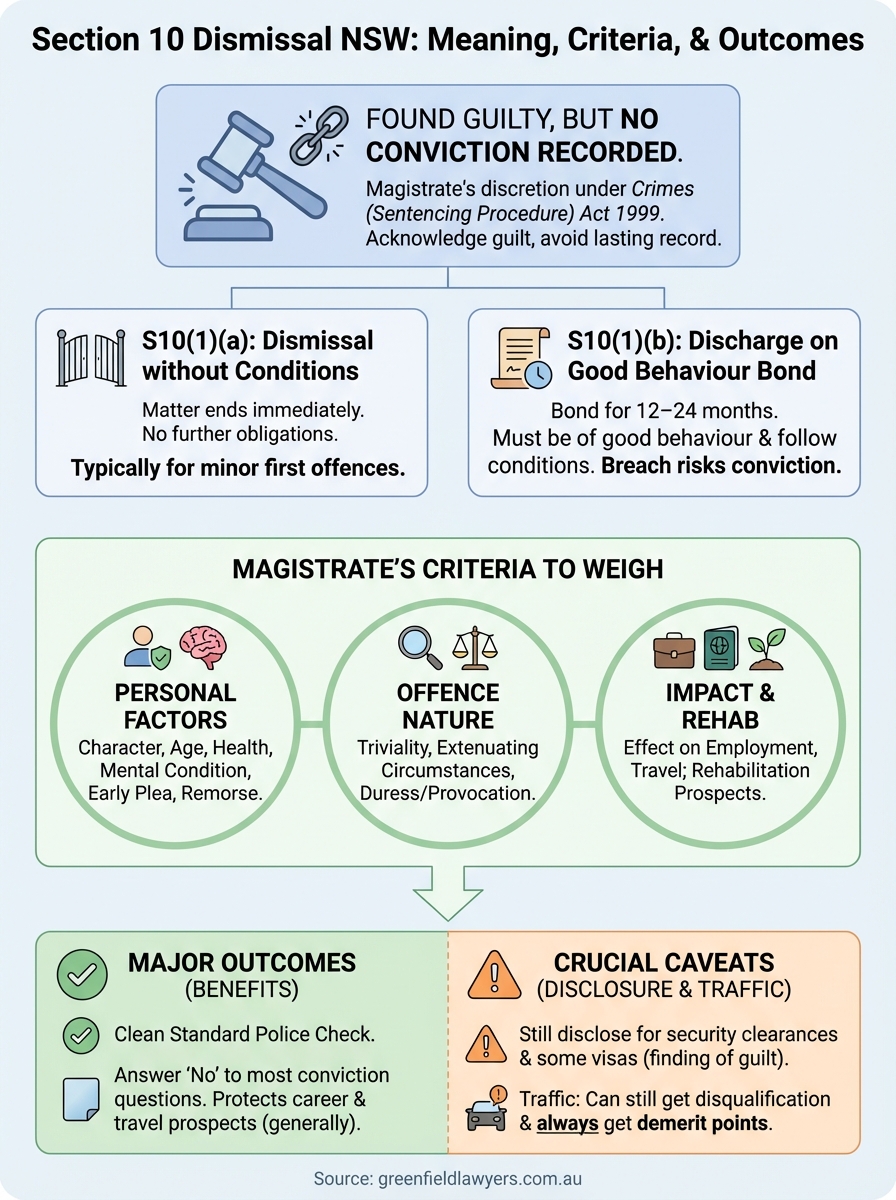
A Section 10 dismissal allows a magistrate to find you guilty of an offence while choosing not to record a criminal conviction against you. This legal option exists under Section 10 of the Crimes (Sentencing Procedure) Act 1999 and gives courts the discretion to recognise that recording a conviction would be disproportionate to the circumstances of your case. You still accept responsibility for the offence, but you walk away without the lasting consequences that come with a criminal record.

The legal foundation of Section 10
Section 10 provides magistrates with two main pathways when they consider your case. Under Section 10(1)(a), the court can dismiss the charges entirely without any conditions attached. Alternatively, under Section 10(1)(b), the magistrate can discharge you on a good behaviour bond for up to two years, which means you must comply with specific conditions during that period. Both options result in no conviction being recorded, though the bond option requires you to demonstrate good behaviour for the specified timeframe.
The fundamental principle behind Section 10 is that the criminal justice system should be flexible enough to recognise cases where recording a conviction would be unjust or disproportionate.
Most Section 10 applications occur in the Local Court for summary offences, though the provision applies across all NSW courts including the District Court for more serious matters. Your legal representative will argue why your particular circumstances warrant this outcome rather than a standard conviction. The magistrate retains complete discretion to either grant or refuse the application based on the evidence presented.
What “dismissal” and “discharge” actually mean in practice
When a magistrate grants a Section 10(1)(a) dismissal, the matter ends immediately with no further obligations on your part. You leave court with a finding of guilt recorded in the court transcript, but this finding doesn’t translate into a criminal conviction for legal purposes. This outcome typically applies to minor first offences where the court determines that the experience of attending court and receiving the guilty finding provides sufficient deterrence.
Key differences from other sentencing options
Understanding how a section 10 dismissal nsw differs from standard sentencing outcomes helps you appreciate why this option matters so significantly. With a regular conviction, the finding of guilt becomes part of your permanent criminal record, which affects employment applications, professional licences, visa applications, and travel to certain countries. A Section 10 outcome avoids all these consequences because no conviction is recorded, even though guilt has been established.
The practical distinction extends beyond just record-keeping. When you receive a Section 10, you can truthfully answer “no” on most employment applications that ask whether you have criminal convictions. However, you must still disclose the matter if asked specifically about findings of guilt or court appearances. Some regulated industries and government positions require disclosure of all court matters regardless of outcome, so you need to understand the specific disclosure requirements for your situation.
Courts view Section 10 orders as genuine sentencing options rather than technical loopholes. Magistrates grant them when they believe that recording a conviction would be unnecessarily harsh given factors like your character, the trivial nature of the offence, exceptional circumstances, or the likely impact on your life. This discretion allows the justice system to balance punishment with proportionality, ensuring that minor mistakes don’t derail your future unnecessarily.
Where Section 10 fits in NSW sentencing law
Understanding where a Section 10 dismissal sits within the broader sentencing framework helps you grasp why magistrates view it as a significant option. NSW courts follow a structured hierarchy of penalties, ranging from the most lenient outcomes through to custodial sentences. A Section 10 occupies the most favourable position on this sentencing ladder, representing the court’s recognition that your circumstances warrant the lightest possible intervention whilst still acknowledging guilt.
The sentencing hierarchy in NSW courts
When a magistrate considers sentencing options, they work through a graduated scale that balances punishment with rehabilitation. At the bottom of this scale, a section 10 dismissal nsw represents the minimum judicial response, where you receive no conviction and no additional penalty. Moving up the hierarchy, the next options include conditional release orders without conviction, fines, community service orders, intensive correction orders, and ultimately full-time imprisonment for serious matters.

Magistrates approach sentencing by first considering whether they can impose a penalty at the lower end of the scale before contemplating harsher options. This principle of proportionality means the court must select the least restrictive sanction that adequately addresses the offence, your circumstances, and community protection needs. Your legal representative will argue that a Section 10 satisfies these objectives without unnecessarily burdening you with a criminal record.
The sentencing hierarchy ensures that courts apply penalties proportionate to both the offence and the offender’s individual circumstances, with Section 10 serving as the foundation of this graduated approach.
Section 10 versus other non-conviction options
Several sentencing alternatives allow magistrates to avoid recording a conviction, but Section 10 remains the most advantageous outcome for you. A conditional release order (CRO) without conviction requires you to comply with specific conditions for up to two years, similar to a Section 10(1)(b) bond, but it appears on your criminal record as a proven offence even though no conviction is recorded. This distinction matters because employers and licensing bodies can still see the proven offence when conducting background checks.
Fines represent another common sentencing option, but magistrates record a conviction when they impose monetary penalties unless they specifically apply Section 10. Some courts combine a Section 10 discharge with requirements for community service, rehabilitation programs, or charitable donations, though these conditions must remain reasonable and proportionate to the offence. Your lawyer will distinguish your case from situations where these alternatives might apply, emphasising factors that support a clean Section 10 outcome.
Courts reserve Section 10 for circumstances where your personal situation, character, or the offence’s nature justifies exceptional leniency. Magistrates won’t grant this outcome simply because you request it; they need compelling evidence that recording a conviction would cause disproportionate harm relative to the offence’s seriousness. Understanding this distinction helps you appreciate why thorough preparation and strong legal representation prove essential when seeking this favourable result.
Types of Section 10 orders and outcomes
NSW courts offer two distinct types of Section 10 orders, each with different conditions and practical implications for your case. Magistrates choose between these options based on the specific circumstances of your offence, your background, and their assessment of what outcome serves justice most appropriately. Understanding the differences between these options helps you prepare realistic expectations when your lawyer applies for a section 10 dismissal nsw in court.
Section 10(1)(a): Dismissal without conditions
A Section 10(1)(a) dismissal represents the most favourable outcome you can achieve after a guilty finding. The magistrate dismisses the charges entirely without imposing any conditions, penalties, or ongoing obligations on you. You walk out of court immediately with no conviction recorded and no further requirements to meet. This option typically applies to first-time offenders who have committed minor infractions, where the magistrate determines that the court experience itself provides sufficient deterrence.
Courts grant unconditional dismissals when they conclude that the circumstances surrounding your offence warrant absolute leniency. Your legal representative will present evidence of your good character, early guilty plea, genuine remorse, and the trivial nature of the offence to support this application. The magistrate exercises complete discretion and will only grant this outcome when satisfied that you pose no risk of reoffending and that recording a conviction would be manifestly unjust.
Section 10(1)(b): Discharge with good behaviour bond
When a magistrate applies Section 10(1)(b), they discharge you on condition that you enter into a good behaviour bond for a specified period, typically ranging from 12 to 24 months. You must not commit any offences during this time, and the court may impose additional conditions such as attending counselling, completing community service, or making charitable donations. This option still avoids recording a conviction, but it requires you to demonstrate ongoing good conduct throughout the bond period.
The good behaviour bond under Section 10(1)(b) protects you from a criminal conviction whilst ensuring you remain accountable for your conduct during the specified timeframe.
Courts favour this option when your offence sits at a more serious level but still doesn’t warrant a conviction, or when the magistrate wants to ensure you maintain proper conduct going forward. If you breach the bond by committing another offence or failing to meet the conditions, the court can revoke the Section 10 and sentence you for the original offence, potentially recording a conviction at that stage.
Practical differences between dismissal and discharge
Choosing between these two pathways depends on factors including the offence’s seriousness, your criminal history, and whether the magistrate believes supervision is necessary. A dismissal under subsection (1)(a) provides immediate finality with no ongoing court involvement, whilst a discharge under subsection (1)(b) maintains some judicial oversight through the bond conditions. Your lawyer will argue for the unconditional option where possible, though accepting a good behaviour bond still achieves the primary objective of avoiding a criminal record.
Criteria a magistrate must consider under Section 10
Magistrates don’t grant Section 10 dismissals based on whim or sympathy. NSW law requires courts to assess specific statutory criteria before deciding whether you deserve this outcome. Section 10(3) of the Crimes (Sentencing Procedure) Act 1999 sets out the exact factors magistrates must evaluate when considering your application. Your legal representative will address each criterion systematically, presenting evidence that supports why your circumstances warrant a section 10 dismissal nsw rather than a recorded conviction.

Your personal character and circumstances
Courts examine your character, background, age, health, and mental condition as primary considerations when evaluating Section 10 applications. Magistrates want to understand who you are beyond the offence itself, looking at factors like your employment history, community ties, family responsibilities, and previous good conduct. Your lawyer will present character references from employers, community leaders, or family members who can attest to your positive reputation and contributions to society.
Age plays a significant role in these decisions, particularly for young offenders who might suffer disproportionate consequences from a criminal record. Health concerns, including physical disabilities or mental health conditions, may explain why you committed the offence or why a conviction would impact you more severely than others. Courts also consider whether you have any prior criminal history, with first-time offenders receiving more favourable consideration than repeat offenders.
The nature and seriousness of the offence
Magistrates assess whether your offence qualifies as trivial in nature or whether extenuating circumstances surrounded its commission. A trivial offence typically involves minimal harm, low monetary value, or behaviour that sits at the lower end of the criminal scale. However, courts don’t view all minor infractions as trivial; they consider the specific context and consequences of your actions when making this determination.
Extenuating circumstances can transform even seemingly serious offences into cases worthy of Section 10 consideration when the full context reveals factors beyond your control or understanding.
Circumstances that might support your application include acting under duress, responding to provocation, making an honest mistake, or facing extraordinary personal pressures at the time. Your lawyer will present evidence showing that recording a conviction would be disproportionate given these surrounding factors and the offence’s overall impact on victims and the community.
Additional factors courts weigh
Beyond the statutory criteria, magistrates consider any other matter they deem relevant to achieving justice in your case. Courts examine the likely effect a conviction would have on your employment, professional registration, travel plans, or family circumstances. They also assess your rehabilitation prospects, remorse, and cooperation with authorities throughout the legal process.
Early guilty pleas demonstrate acceptance of responsibility and save court resources, which magistrates view favourably. Actions you’ve taken since the offence, such as attending counselling, making restitution, or addressing underlying issues like substance abuse or anger management, strengthen your application significantly.
When a Section 10 is commonly available
Courts grant Section 10 dismissals most frequently in situations where recording a conviction would create disproportionate consequences compared to the offence’s actual seriousness. While magistrates retain complete discretion in every case, certain patterns emerge across NSW courtrooms that indicate when you stand a stronger chance of securing this outcome. Understanding these common scenarios helps you assess whether your circumstances align with cases where courts typically exercise leniency, though no two cases are identical and past patterns never guarantee future results.
First-time offenders facing minor charges
Courts show the greatest willingness to grant section 10 dismissal nsw outcomes for individuals who have never faced criminal charges before and whose offence sits at the lower end of the severity scale. First-time offenders who committed shoplifting of low-value items, minor traffic infractions, or low-range drink driving frequently receive Section 10 consideration, particularly when they demonstrate genuine remorse and have otherwise led law-abiding lives. Magistrates recognise that everyone makes mistakes and that a criminal record can derail someone’s future disproportionately when the offence reflects an isolated lapse rather than a pattern of criminal behaviour.
Your prospects improve substantially when you can show the offence occurred during unusual circumstances that are unlikely to repeat. Perhaps you acted under significant personal stress, made an honest error of judgment, or responded to a situation you had never encountered before. Courts grant Section 10 orders for possession of small quantities of drugs when you’ve already sought rehabilitation, minor assaults resulting from single confrontations, and property damage caused accidentally or in situations involving provocation.
Professional and employment considerations
Magistrates frequently grant Section 10 dismissals when a conviction would directly threaten your professional registration, security clearance, or employment in ways that exceed reasonable punishment for the offence. Teachers, nurses, lawyers, police officers, and other registered professionals face automatic reporting requirements and potential deregistration when convicted of criminal offences. Courts recognise that losing your career represents a disproportionately severe consequence for minor infractions that don’t reflect on your professional competence or integrity.
Courts actively consider whether a conviction would destroy your livelihood and future prospects in ways that exceed what the offence itself warrants, particularly when your profession requires clean records.
International travel requirements also support Section 10 applications when you need visa eligibility for work, study, or family reunion purposes. Countries including the United States, Canada, and the United Kingdom impose strict entry restrictions on people with criminal convictions, and magistrates understand that a recorded conviction might permanently separate you from career opportunities or family members overseas.
Young offenders and rehabilitation prospects
Courts show particular flexibility when sentencing young adults whose brains haven’t fully matured and whose rehabilitation prospects remain excellent. Magistrates recognise that people aged 18 to 25 often display poor judgment that doesn’t reflect their true character or future behaviour, making Section 10 dismissals appropriate when the alternative would burden them with permanent records for youthful mistakes. Young offenders who demonstrate they’ve learned from the experience and taken steps to address underlying issues receive favourable consideration.
How to apply for a Section 10 in court
Securing a section 10 dismissal nsw requires strategic preparation and persuasive presentation rather than simply requesting leniency when you appear before the magistrate. The application process begins well before your court date and involves gathering compelling evidence, preparing detailed submissions, and understanding exactly what arguments will resonate with the judicial officer hearing your case. Courts expect you to demonstrate why your circumstances warrant this exceptional outcome through concrete evidence and structured legal argument, not emotional appeals or vague promises about future behaviour.
Preparing your Section 10 application before court
Your preparation should start immediately after charges are laid, giving you maximum time to gather the character references, supporting documents, and professional reports that strengthen your application. You need character references from employers, community leaders, teachers, or respected members of society who can speak to your good reputation and positive contributions. These references should address specific qualities rather than generic praise, explaining how the writer knows you and providing concrete examples of your integrity, reliability, and community involvement.
Beyond character evidence, you should obtain any documents that demonstrate the offence’s circumstances or your rehabilitation efforts. Medical reports explaining mental health conditions or physical limitations that contributed to the offence support your case significantly. Completion certificates from counselling programs, anger management courses, or rehabilitation services show you’ve taken active steps to address underlying issues. Employment contracts or university acceptance letters help magistrates understand what you stand to lose if they record a conviction.
The strength of your Section 10 application depends entirely on the quality and relevance of the evidence you present, making thorough preparation essential rather than optional.
What happens during the court hearing
When your matter is called, your lawyer will enter a guilty plea on your behalf and immediately apply for the court to consider a Section 10 dismissal. The magistrate will hear a summary of the offence facts from the police prosecutor, which your lawyer may dispute if any details are inaccurate or unfairly prejudicial. This factual agreement establishes the baseline from which your lawyer builds the Section 10 argument, so ensuring accuracy at this stage protects your interests throughout the remaining process.
Presenting evidence and submissions to the magistrate
Your legal representative then addresses each statutory criterion under Section 10(3) systematically, tendering your character references, medical reports, and supporting documents as exhibits. They will explain your personal circumstances, emphasise your good character, highlight the offence’s trivial nature or extenuating circumstances, and demonstrate the disproportionate impact a conviction would have on your employment, education, or travel plans. Magistrates appreciate structured submissions that directly address the legal requirements rather than rambling narratives about hardship.
The prosecutor may oppose your application by highlighting the offence’s seriousness or questioning whether you deserve leniency. Your lawyer responds to these objections and reinforces why justice requires a Section 10 outcome in your specific case. The magistrate then considers all evidence and arguments before announcing their decision, either granting or refusing the application.
What it means for your record, work, and travel
Understanding the practical implications of receiving a section 10 dismissal nsw helps you appreciate why this outcome matters so significantly beyond the courtroom. While magistrates find you guilty of the offence, they don’t record a conviction against you, which fundamentally changes how the matter affects your criminal record, employment prospects, and international travel plans. This distinction creates tangible benefits that extend throughout your personal and professional life, though you still need to understand exactly what obligations and limitations apply after receiving this outcome.
Criminal record implications
When a court grants a Section 10 dismissal, the matter doesn’t appear on your national police check or criminal record in the way a conviction would. Standard criminal history checks conducted by employers, volunteer organisations, or licensing bodies won’t show the offence because no conviction was recorded. You can truthfully answer “no” when most job applications ask whether you have criminal convictions, giving you the same opportunities as someone who has never faced charges.
However, the court maintains a record that you appeared and received a guilty finding, even though they didn’t record a conviction. Some government positions, regulated professions, and security clearances require disclosure of all court appearances and findings regardless of whether a conviction resulted. You must carefully read the specific questions on these applications because failing to disclose required information constitutes fraud, even when you received a Section 10 outcome.
Employment and professional licensing effects
Professional registration boards vary in their treatment of Section 10 outcomes when assessing your fitness to practice. Medical boards, teaching authorities, and legal regulators typically require notification of criminal charges or findings of guilt regardless of whether a conviction was recorded. Your Section 10 dismissal may still trigger mandatory reporting obligations, though these bodies often view the absence of a recorded conviction favourably when deciding whether your registration should continue.
Private employers conducting standard background checks won’t discover your Section 10 matter unless you disclose it voluntarily. Jobs requiring government security clearances or working with vulnerable people involve enhanced vetting procedures that may uncover court records even without convictions. Your safest approach involves understanding exactly what each application requires and seeking legal advice before completing disclosure sections.
The practical difference between a Section 10 and a recorded conviction becomes most apparent when you apply for positions, licences, or opportunities that require clean criminal records for eligibility.
International travel and visa applications
Countries including the United States, Canada, and the United Kingdom ask visa applicants whether they have criminal convictions, arrests, or charges on their records. A Section 10 dismissal allows you to answer “no” to conviction questions, though you must disclose arrests or charges if the application specifically requests that information. Immigration authorities focus primarily on recorded convictions when assessing visa eligibility, making your Section 10 outcome far less problematic than a standard guilty plea with conviction.
Australia’s own visa requirements for foreign nationals specifically reference convictions rather than court appearances, meaning your Section 10 won’t affect sponsoring overseas family members or employees. You maintain the same travel freedoms and opportunities as people without criminal records, though you should always read visa application questions carefully and consult immigration lawyers if any ambiguity exists about disclosure requirements.
Traffic offences, licence impacts, and demerit points
Traffic matters represent one of the most common categories where you might seek a section 10 dismissal nsw outcome, though the interaction between court decisions and Roads and Maritime Services (RMS) rules creates confusion for many drivers. Courts can grant Section 10 dismissals for traffic offences ranging from speeding and mobile phone use through to drink driving and negligent driving, potentially sparing you from a criminal conviction. However, you need to understand that receiving a Section 10 doesn’t automatically protect your driving licence or prevent demerit points from accruing, because RMS operates under separate legislation that governs licence suspensions independently of court conviction decisions.

How Section 10 affects your driving licence
When a magistrate grants you a Section 10 dismissal for a traffic offence, they exercise discretion about whether to disqualify your licence as part of the sentencing process. Courts can impose licence disqualification periods even when they don’t record a conviction, though magistrates who grant Section 10 orders typically avoid this additional penalty unless road safety concerns demand it. You might receive a Section 10 without any disqualification period attached, meaning you keep your licence and avoid a criminal record simultaneously.
Drink driving matters complicate this picture because legislation mandates minimum disqualification periods for certain blood alcohol concentration levels. Magistrates cannot reduce these mandatory periods below the statutory minimums even when granting Section 10 dismissals, so you might receive the favourable outcome of no conviction whilst still losing your licence for the prescribed timeframe. Your lawyer will explain which offences carry mandatory disqualification requirements and whether the magistrate has any flexibility to avoid or reduce the suspension period in your specific case.
Courts balance your need to maintain employment and family responsibilities against community safety when deciding whether to impose licence disqualifications alongside Section 10 dismissals.
Demerit points and Section 10 dismissals
RMS demerit point rules operate independently from court conviction decisions, creating a situation where you can receive a Section 10 dismissal yet still accumulate demerit points on your driving record. The demerit point system responds to proven offences rather than recorded convictions, so magistrates who find you guilty but don’t record a conviction still trigger the demerit point consequences under transport legislation. You cannot avoid demerit points simply by securing a Section 10 outcome, though you do avoid the criminal record implications that affect employment and travel.
Professional drivers and learners face licence suspension when they reach lower demerit point thresholds, making the accumulation of points particularly concerning even when courts show leniency through Section 10 orders. Your total demerit points determine whether RMS suspends your licence administratively, completely separate from any court-imposed disqualification periods.
Limits, risks, and what happens if it is refused
Not every case qualifies for a section 10 dismissal nsw outcome, and magistrates refuse applications regularly when the circumstances don’t warrant such leniency. Courts maintain strict standards about when they exercise this discretion, meaning you face real risks if you pursue this outcome without proper preparation or when your offence sits outside the acceptable range for dismissal. Understanding these limitations before you apply helps you make informed decisions about whether to request a Section 10 or accept alternative sentencing options that might prove more realistic given your situation.
Offences that rarely qualify for Section 10
Magistrates refuse Section 10 applications for serious violent offences, sexual crimes, or matters involving significant harm to victims regardless of your personal circumstances or character evidence. Courts view these offences as inherently too grave to dismiss without recording convictions, recognising that community safety and victim rights outweigh your individual interests. Repeat offenders face similar difficulties securing Section 10 outcomes because your criminal history demonstrates a pattern of unlawful behaviour that courts cannot overlook simply because you now express remorse or face consequences.
High-range drink driving, drug supply charges, and assaults causing actual bodily harm typically exceed the threshold where magistrates feel comfortable exercising leniency. Your prior convictions, breached court orders, or aggravating circumstances surrounding the current offence substantially reduce your prospects of success. Courts also reject Section 10 applications when you demonstrate no genuine remorse, fail to accept responsibility, or continue engaging in behaviour that led to the charges.
What happens when magistrates refuse the application
When a magistrate refuses your Section 10 application, the court proceeds immediately to standard sentencing for the offence you’ve been found guilty of committing. The magistrate considers the full range of available penalties including fines, community correction orders, intensive correction orders, or imprisonment depending on the offence’s maximum penalty. You receive a recorded conviction that appears on your criminal record and triggers all the employment, licensing, and travel consequences you hoped to avoid.
Courts exercise their discretion to refuse Section 10 applications when granting such outcomes would undermine public confidence in the justice system or fail to adequately denounce your criminal conduct.
Standard convictions remain on your record permanently for serious indictable offences, while summary convictions may become spent after 10 years of crime-free behaviour under the Criminal Records Act 1991. You face immediate disclosure obligations for job applications, professional registrations, and visa applications that specifically ask about criminal convictions, fundamentally changing your prospects in ways a Section 10 would have prevented.
Appeal options if your Section 10 is denied
You can appeal a magistrate’s refusal to grant a Section 10 dismissal by lodging an appeal to the District Court within 28 days of the sentencing decision. The District Court reviews whether the magistrate made errors in exercising their discretion or failed to properly consider relevant factors supporting your application. Appeals require you to demonstrate specific legal errors rather than simply arguing the magistrate should have been more lenient, making professional legal representation essential for any realistic prospect of success.
District Court judges possess the same discretion to grant Section 10 orders on appeal, though they often show reluctance to overturn Local Court sentencing decisions absent clear errors. You must weigh the costs of appealing against the likelihood of success and consider whether accepting the original sentence allows you to move forward more quickly than prolonging court proceedings through appeals.
Next steps
Pursuing a section 10 dismissal nsw requires thorough preparation, strategic legal argument, and compelling evidence that addresses the statutory criteria magistrates must consider. Your prospects improve dramatically when you engage experienced criminal defence lawyers early in the process, allowing time to gather character references, obtain relevant reports, and build a persuasive case for why your circumstances warrant this exceptional outcome. The difference between success and failure often comes down to how effectively your legal team presents your case and responds to prosecution objections.
At Greenfield Lawyers, we’ve secured Section 10 dismissals for countless clients across Sydney, protecting their futures from the lasting consequences of criminal records. Our 40 years of combined experience in criminal defence law means we understand exactly what magistrates need to see and how to present your case most effectively. Contact our criminal defence team today to discuss your charges and explore whether a Section 10 outcome remains achievable in your situation.


About Post Author
