Crimes Sentencing Procedure Act NSW: Key Sections Explained
At Greenfield Lawyers, our Sydney-based criminal defence team works with this Act daily. We’ve seen how specific sections directly shape our clients’ futures, from conditional release orders to intensive correction orders and everything in between. Knowing the law is essential, but knowing how courts actually apply it matters just as much.
This article breaks down the critical sections of the Crimes (Sentencing Procedure) Act 1999, explaining sentencing purposes, available penalties, and the factors courts must consider. Whether you’re researching for yourself or preparing for a matter before the courts, you’ll find a clear, practical guide to NSW sentencing law below.
What the Act covers and who it applies to
The Crimes (Sentencing Procedure) Act 1999 sets out the framework for how courts in New South Wales impose penalties on convicted offenders. It applies to all criminal and summary offences heard in NSW courts, from Local Court matters to Supreme Court trials. The Act covers both adults and young offenders (those aged 18 and over at the time of sentencing), though separate legislation governs children under 18.
Who falls under the Act
You fall under this legislation if you’ve been convicted or found guilty of an offence in NSW, regardless of whether you pleaded guilty or went to trial. The Act applies equally to first-time offenders and repeat offenders, though your criminal history will affect the sentence you receive. Courts use the Act’s provisions when sentencing Australian citizens, permanent residents, and international visitors alike. Your immigration status doesn’t exempt you from its application, though it may influence the type of penalty a court considers appropriate.
If you’re convicted of a crime in NSW, this Act determines what penalties the court can impose and how it decides between them.
What types of offences the Act governs
The crimes sentencing procedure act nsw covers everything from minor summary offences (like shoplifting or low-range drink driving) to serious indictable crimes (including assault, drug supply, and fraud). It doesn’t create the offences themselves, but it governs the sentencing process once you’ve been found guilty. The Act applies to offences under NSW legislation and some Commonwealth crimes when they’re dealt with in NSW courts. It excludes certain matters handled under specialised laws, such as terrorist offences with mandatory minimum sentences or specific Commonwealth sentencing regimes. Courts rely on the Act to determine available sentencing options, mandatory considerations, and how to balance punishment with rehabilitation. Understanding its scope helps you anticipate which sections might apply to your specific charges.
Purposes and principles of sentencing in NSW
Courts in New South Wales don’t impose penalties randomly. Section 3A of the Crimes (Sentencing Procedure) Act 1999 sets out five statutory purposes that guide every sentencing decision. These purposes work together to balance punishment with rehabilitation, ensuring sentences serve both the individual offender and the wider community. Judges must consider all five purposes, though their relative importance shifts depending on the offence and your circumstances.
The five statutory purposes
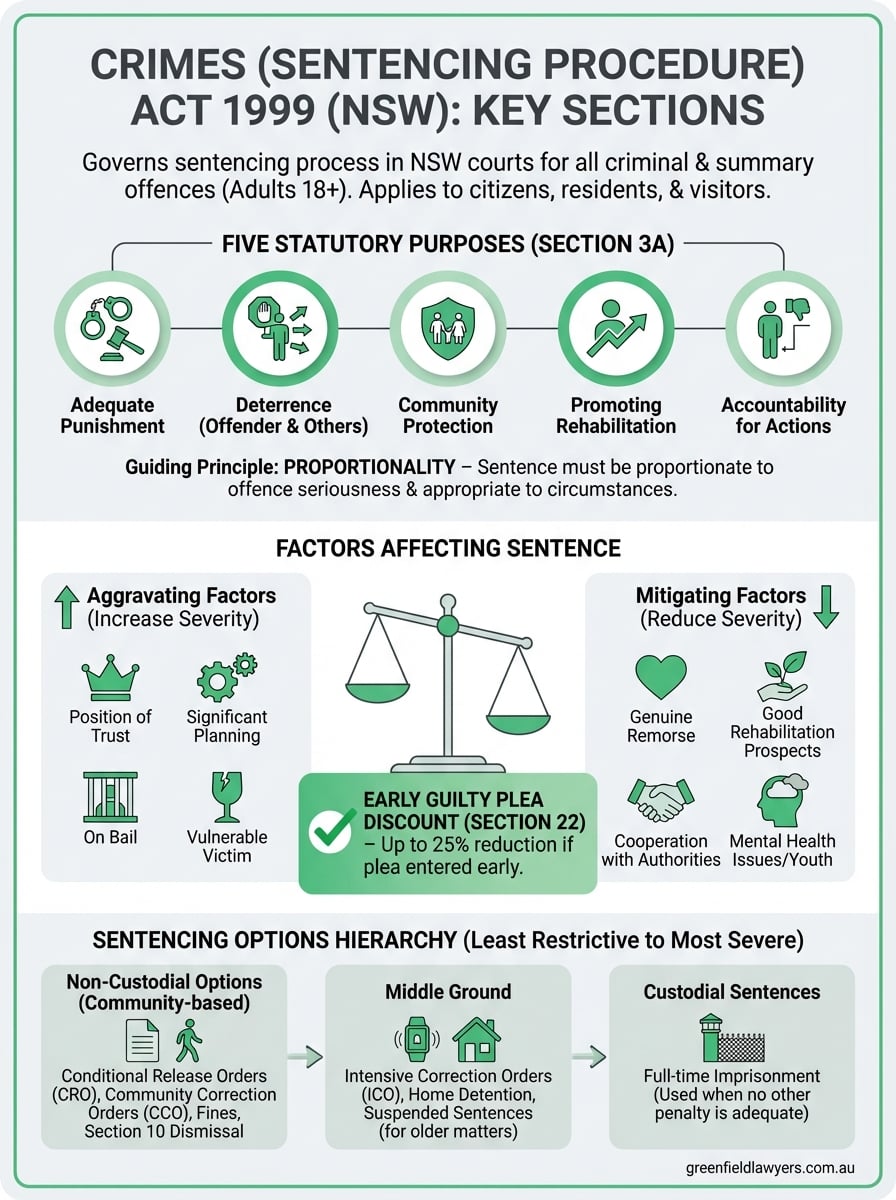
The Act requires courts to consider adequate punishment for the offence, deterrence (both for you and others), protection of the community, promoting rehabilitation, and making offenders accountable for their actions. No single purpose dominates in every case. For a violent offender with multiple prior convictions, deterrence and community protection might carry more weight. For a first-time offender who pleaded guilty early, rehabilitation and accountability often take priority.
Courts must balance all five purposes when determining your sentence, not simply focus on punishment alone.
Proportionality as the guiding principle
Proportionality sits at the heart of NSW sentencing law. Your penalty must be proportionate to the seriousness of your offence and appropriate for your circumstances. Courts achieve this by weighing objective factors (the crime’s nature and impact) against subjective factors (your background, prospects, and remorse). This principle prevents excessive punishment while ensuring serious crimes receive appropriate consequences. The crimes sentencing procedure act nsw embeds proportionality throughout its framework, requiring judges to justify their decisions with reference to established sentencing patterns for similar offences.
Key factors and discounts that change a sentence
Once a court determines the appropriate sentencing range for your offence, several factors can push your penalty higher or lower. The crimes sentencing procedure act nsw requires judges to weigh aggravating circumstances (which increase severity) against mitigating circumstances (which reduce it). Understanding these factors helps you anticipate how courts will assess your case and what discounts might apply to your situation.
Aggravating and mitigating factors
Aggravating factors make your offence more serious. Courts consider whether you held a position of trust, whether the crime involved significant planning, whether you committed the offence whilst on bail, and whether the victim was particularly vulnerable. Multiple prior convictions also aggravate your sentence, particularly if they demonstrate a pattern of similar behaviour.
Mitigating factors work in your favour. Courts reduce penalties when you demonstrate genuine remorse, have good prospects of rehabilitation, cooperate with authorities, or face circumstances that partially explain (but don’t excuse) your conduct. Your personal circumstances matter: mental health issues, youth, limited criminal history, and family responsibilities all carry weight. The court balances these factors against the objective seriousness of what you did.
The early guilty plea discount
Section 22 of the Act provides a mandatory discount when you plead guilty early. Courts must reduce your sentence by up to 25% if you enter your plea at the earliest reasonable opportunity, typically at your first court appearance. The discount reduces progressively the later you plead guilty. This provision recognises that early pleas save court resources and spare victims from giving evidence.
Pleading guilty early can reduce your sentence by up to a quarter, regardless of the offence.
Sentencing options and when courts use them
The crimes sentencing procedure act nsw provides courts with a hierarchy of penalties ranging from non-custodial orders to full-time imprisonment. Courts start by considering the least restrictive option that serves the sentencing purposes and only move to harsher penalties when community-based options prove inadequate. Your offence’s objective seriousness, criminal history, and prospects of rehabilitation determine which option the court selects.

Non-custodial options
Courts favour community-based penalties for less serious offences or first-time offenders who demonstrate rehabilitation prospects. A conditional release order (CRO) allows you to remain in the community without conviction, provided you comply with conditions like good behaviour bonds. Community correction orders (CCOs) impose more substantial requirements, including community service, supervision, or rehabilitation programmes. Fines punish financial capacity rather than liberty, though courts must consider your ability to pay. Section 10 dismissals or conditional release orders without conviction preserve your clean record whilst holding you accountable.
Courts prefer keeping you in the community unless your offence’s seriousness or risk to public safety demands otherwise.
Custodial sentences and alternatives
Full-time imprisonment applies when no other penalty adequately serves the sentencing purposes. Courts use this option for serious violent crimes, large-scale drug offences, or repeat offenders who’ve failed community-based orders. Intensive correction orders (ICOs) allow you to serve sentences under two years in the community under strict supervision, provided you’re not convicted of certain violent or sexual offences. Home detention and suspended sentences (for older matters) offer middle-ground options between community orders and gaol.
Common questions and where to read the Act
You’ll likely have questions about how specific sections apply to your charges. Clients regularly ask us whether their circumstances qualify for particular discounts, which sentencing option suits their situation, and how courts calculate time already served in custody. The crimes sentencing procedure act nsw addresses these matters through specific provisions, but applying them correctly requires understanding how courts interpret the legislation in practice.
Where to access the full Act
The complete legislation sits on the NSW Legislation website, maintained by the Parliamentary Counsel’s Office. You can read every section, amendment, and explanatory note without charge. The official version includes cross-references to relevant case law and links to related legislation. Search for “Crimes (Sentencing Procedure) Act 1999” to find the current consolidated version, which incorporates all amendments up to the present date.
Reading the Act directly helps you understand the legal framework, but court decisions determine how judges actually apply each provision.
Questions courts regularly address
Courts constantly interpret whether your circumstances warrant exceptional leniency or require harsher penalties. Common questions include how multiple offences affect your sentence, whether courts can backdate sentences to custody already served, and what conditions apply to community-based orders. Judges also determine if your rehabilitation prospects justify non-custodial options and whether aggravating factors outweigh mitigating ones. These decisions turn on specific facts rather than automatic formulas.
Next steps if you have a court date
Understanding the crimes sentencing procedure act nsw gives you essential knowledge, but applying it effectively requires skilled legal representation. Your lawyer must analyse how courts interpret specific sections in cases similar to yours, identify available discounts, and present your circumstances persuasively to achieve the best possible outcome.
Preparation determines results. Gathering character references, arranging rehabilitation programmes before sentencing, and demonstrating genuine remorse all strengthen your position. Courts respond favourably when you show concrete steps towards change rather than empty promises. Your criminal history, the offence’s objective seriousness, and how you present yourself all influence which sentencing option the court considers appropriate.
We represent clients facing all criminal charges across Sydney’s courts. Our team knows how prosecutors argue sentencing submissions and how judges weigh competing factors. Contact our criminal defence lawyers to discuss your charges and build a strategy that maximises your prospects for leniency.


About Post Author
